Sedona, Arizona
About Sanatya
and Michael
Sanatya is a Lighthouse for Human Awakening. Here's how you can work with us.
Embodiment coaching, sacred land journeys, breathwork, men's and couples' retreats, and sacred union mentorship.
1:1 and small group, based in Sedona.
1 hour discovery call · No pitch, no pressure
- Sessions in English and Spanish
- 1:1 coaching by application
"Michael is one of the most incredible people I’ve ever met! He has an exceptional ability to show people the light within themselves."
- Chauncy H.

What Sanatya means
The name pulls from three roots that sit at the foundation of how Michael approaches the work.
Satya
Truth
In Vedic tradition, linked to Satya Yuga, the age associated with clarity and integrity before the layers of obscuration accumulate. The orientation isn't toward a truth that has to be constructed or performed. It's toward what's already there to be recognized.
Śūnyatā
openness ·
spaciousness
Often translated as "emptiness," though that translation can be misleading. The sense it points to is the open ground from which experience arises. Not absence. Spaciousness underneath form. In contemplative traditions, the encounter tends to feel less like void and more like room. A kind of internal space that wasn't there before.
Sananda
indwelling presence
A name found across multiple traditions, pointing to the indwelling divine presence. In Michael's framing, this connects to the awakening of Christ-consciousness - divinity already here, not as religious doctrine but as direct recognition. The work doesn't introduce something foreign. It points to what was always present underneath.
About Michael
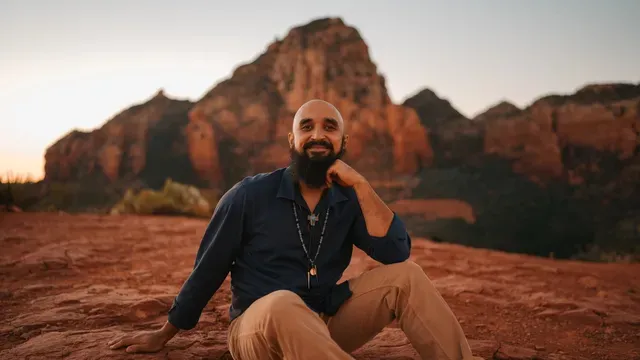
Michael Pupiales is a certified breathwork practitioner, men's coach, and transformational speaker based in Sedona, Arizona. He's worked primarily with men in 1:1 containers, small group settings, and retreat work on the land over the past decade.
His academic background is in Health and Exercise Science (BS, Colorado State University). His breathwork training came after, through the LOKA School of Yoga, in the lineage of Swami Satyananda Saraswati. That foundation is classical Vedic pranayama, taught as a complete system rather than a single technique: asana, pranayama, mudra, and bandha treated as integrated parts of one practice. His broader training includes modern approaches to nervous system regulation and emotional processing. Putting you in tune with what's actually happening in the body when something shifts.
The work he facilitates isn't theoretical. He came to it through his own. During his time at Colorado State, he had what he describes as an awakening vision. An experience that pointed him toward a different relationship with his life and pulled him into a practice that's continued for over a decade since. That practice has included Vipassana meditation, ceremony with indigenous elders, modern somatic work, and deep integration work.
The path wasn't an academic interest. It came out of his own addiction recovery, self-doubt, and a period of real disorientation about what his life was for. The work he teaches now is the work that brought him through.
Outside of coaching and retreat work, Michael speaks publicly on themes of remembrance, presence, and embodiment. He co-facilitates couples retreats with his wife, Omkari.
Credentials
- BS Health & Exercise Science (CSU)
- Certified breathwork practitioner
- LOKA School of Yoga · Satyananda lineage
- Decade-plus personal practice
- Vipassana · ceremony · somatic
What the work is rooted in
Michael’s work is rooted in breathwork, somatic practice, ceremony, meditation, and time on the land.
Rather than following a rigid method or curriculum, each session is shaped by what is actually present: in the body, in the nervous system, in the story being carried, and in the deeper truth asking to be heard.
His facilitation is intuitive, relational, and grounded. Breathwork is used to open the body and quiet the mind. Somatic practice supports regulation, awareness, and integration. Ceremony creates a threshold where something deeper can be met with honesty and reverence.
The work may also draw on Qi Gong, embodied movement, creative practice, and nature-based immersion. But the heart of it remains simple: Michael does not approach the man across from him as a problem to fix, but as someone carrying strength, clarity, and wisdom that may have been covered over.
The work creates space for that deeper truth to surface; not through force, performance, or another set of instructions, but through presence, practice, and honest encounter.
How the practice is structured
Sanatya operates as an intentional & intimate practice by design. Michael only accepts a small number of sincere clients at any given time. 1:1 coaching is the primary container. Monthly sessions by Zoom or phone, structured around what you are actually working with rather than a predetermined program. Twice a year, Michael facilitates a small group container with a defined arc and a specific focus. Retreats happen in Sedona, capped at small group size, typically ten men or fewer, so that the work has room to be real. Couples retreats are bespoke, co-facilitated, and built around the specific intentions of the couple.
01
1:1 coaching
Monthly · Zoom or phone · primary container
02
Group container
Twice a year · defined arc
03
Men's retreat
Sedona · 10 men · bi-annual
04
Couples retreat
Bespoke · co-facilitated · 3–7 days
Para hombres con raíces latinas.
Michael is Colombian-American and works in both English and Spanish. Many Latino men grow up holding deep spiritual and familial inheritance and an unspoken expectation to carry it alone. That inheritance is foundational in the work, not a background detail. Sessions in Spanish are not translation. They're how the work happens, in the language and frame it was always meant to happen in.
The guiding principle
Truth remembered is only the beginning. Truth embodied is the work.
If anything here resonates
The first step is a discovery call. A short, real conversation about what you're working with and whether this is the right fit.
1 hour discovery call
Reviewed within 48 hours
FAQs
Find answers to commonly asked questions about Sanatya and our services.
Who does Michael primarily work with?
Men, mostly. Most are between 30 and 60. Past the early career-building stage and clear that something underneath is asking for attention. Some come from a specific spiritual tradition; many don't. The common thread is readiness, willingness and sincerity.
Why does Michael work primarily with men?
A specific intent of the practice is creating containers where men can do inner work without performing, and many of the patterns men carry move differently in single-gender settings. Michael also has lived experience navigating the territory men tend to come in with. Couples retreats are the exception, where the work involves both partners by design.
Is this a religious practice?
No. The frame draws on multiple traditions: Vedic pranayama, contemplative practice, ceremonial work, and the recognition of indwelling divinity that some traditions call Christ-consciousness. It isn't tied to a single religion or belief system. Men come from a range of backgrounds, including no formal tradition.
How is this different from therapy?
Coaching isn't therapy and isn't a substitute for it. If you're treating clinical conditions or in active mental health crisis, a licensed clinician is the right fit. Coaching is for men who are functional in their lives and want a deeper container for inner work.
Do I need to be in Sedona to work with Michael?
No. 1:1 coaching is remote. Zoom or phone, monthly. Retreats happen in Sedona; the rest of the practice can happen anywhere.
Receive Monthly Transmissions
Join our wisdom circle for insights, event announcements, and potent inspiration from Michael.
Sanatya
Sanatya exists to help humanity remember who we truly are beneath the conditioning, distractions, and wounds of modern life. Through spiritually grounded mentorship, breathwork, embodiment practices, and transformative experiences, we guide men and couples back to their divine nature and into lives of greater purpose, presence, and service.
Contact
© 2026 Sedona, Arizona USA · All rights reserved · Hosted by Trade Hive